Built with Claude · Life Sciences · Research track

Same amount.
Opposite fate.

Two cells can hold the same number of mitochondria for opposite reasons — one is building them, the other has stopped clearing them. Count how many are there and they look identical. Read the direction instead, and you can predict which cancers are addicted to their mitochondria and which drugs will hit them.

Two cells holding the same number of mitochondria for opposite reasons Two identical cells each contain nine mitochondria. Despite the identical count, the first cell's biogenesis machinery is dominant while the second cell's selective-clearance machinery is dominant, giving them opposite net directions: building versus clearing. Cell A Cell B 9 mitochondria 9 mitochondria biogenesis clearance biogenesis clearance net direction + building net direction − clearing

Identical counts, opposite states. The count is what a conventional signature reports; the direction is what the cell is actually doing — and in 1,066 cancer cell lines it is Cell A, the one still building, that dies when you switch its mitochondrial machinery off.

The one idea

A standard organelle signature answers “how much is there.” But build-up and tear-down move many of the same genes, so a single-axis score cannot tell a cell that is proliferating mitochondria from one whose disposal machinery has stalled — and the genes that would separate them, the selective-autophagy receptors, are usually not in the signature at all.

So we score the two opposing programs separately and subtract them:

biogenesisselective degradation = net direction

One signed number per sample, from an ordinary transcriptome, proteome, or phosphoproteome. Positive means net building; negative means net clearing. It is a set-point — which program dominates right now — validated against timecourses where the true direction is known. It is not an organelle headcount and not a measured rate.

What direction buys you

ρ = −0.35
Predicts genetic vulnerability
1,066 cancer cell lines, DepMap CRISPR. p = 1.7×10⁻³²; negative in 17 of 18 lineages.
#1 of 1,514
Picks the drug, unsupervised
MitoQ ranks first across the PRISM library; IACS-010759, in clinical trials, lands in the top 3%.
0.666 vs 0.613
Direction beats amount
AUROC on the same vulnerability endpoint — signed direction against raw expression.
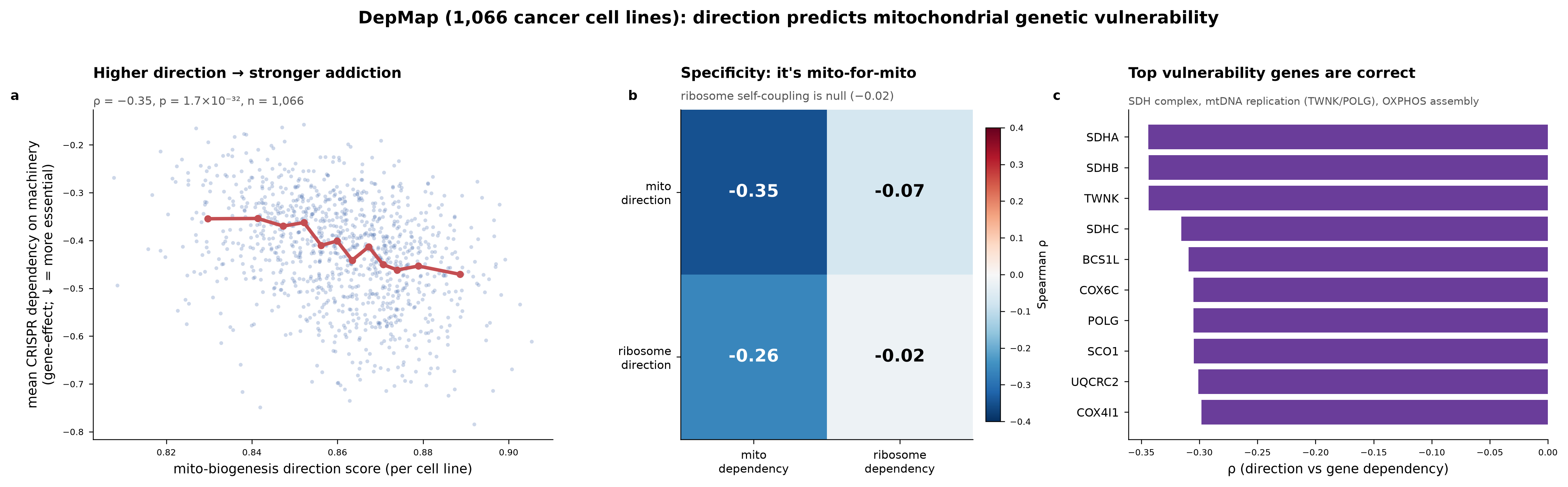
Scatter of net direction against CRISPR gene-effect across 1,066 DepMap cancer cell lines, with lineage and burden controls.
The more a cell line is building mitochondria, the harder it dies when you switch that machinery off. Nothing about drug or gene function was given to the score.

Where it holds, and where it doesn't

ClaimResultData
Direction → genetic vulnerabilityρ = −0.35, n = 1,066DepMap CRISPR
↳ survives dependency-burden controlpartial r = −0.32
Direction → drug responsemito-drug class MWU p = 0.017DepMap PRISM
Cross-modal agreement in human tumourRNA g = −1.52 · protein g = −3.14CPTAC ccRCC
Graded by organelle, as biology predictsmito −0.35 · ER −0.15 · lysosome nullDepMap
Survival in kidney cancer — reported nullCox p = 0.21 at 8× the powerTCGA-KIRC, 508 tumours

Effect sizes are modest, as expected for a single-pathway expression score predicting a functional phenotype across heterogeneous cell lines. The value is a real, specific, lineage-robust, correctly-signed signal — not a high-accuracy point predictor.

Things we tried to break first

Run it on your own data

git clone https://github.com/different-change/organelle-direction
cd organelle-direction/scorer
python run_dynamics.py --self-check
python run_dynamics.py --expression your_matrix.csv \
    --organelle mitochondrion --organism human

Sixteen curated modules ship with it — seven organelles across yeast, Arabidopsis, rice and human, each gene resolver-backed with provenance. The engine is organelle-agnostic: drop in a new pair of gene-set CSVs and it scores that.

The selective-clearance arm is populated wherever a genuine selective-autophagy receptor exists and empty where none is known — including every plant organelle. That pattern is biology, not a defect, and the tool reports it rather than hiding it.